Founding partners

Help communities understand what’s changing. And prepare for what’s next.

ICI is free for anyone. It shows what the weather has done near a building, what that can mean for the building, and what to do about it. Founding sponsors help keep it free and bring it to more communities.

  • Free for anyone to use
  • Canada and the United States
  • Every figure names its source
A waterfront walkway beside a planted rain garden, with mid-rise buildings and a city skyline beyond.
Illustrative photograph. It does not show a particular community.

From the Earth Almanac

Calgary (Airport) station

Climate normals 1991–2020, Environment and Climate Change Canada

Heating degree days below 18 °C
4,994a year
Days below −20 °C
21.6a year
Snowfall
139 cma year

Why this matters

Buildings live with their weather. The information about it is scattered.

  1. Conditions change over a building’s life

    Cold, heat, heavy rain, snow, freeze-thaw and wildfire smoke all act on a building and its equipment, and a building stays in service for decades while they do.

  2. The record sits in many places

    Station records, official warnings, recall notices and what an owner knows about a building rarely sit side by side. Most people never see them together.

  3. Decisions are made without it

    Repairs, replacements and preparation are often decided before anyone can see what a place has experienced, what a building has and what is still unknown.

ICI at a glance

Operating today

  • The Earth Almanac: climate normals, current observations and official weather alerts for Canada and the United States
  • Living Earth: a map of terrain, lakes and rivers, climate stations and floods recorded in Canada, each with its source
  • Check a building and its dated Condition Profile
  • Equipment lookup and official recall notices
  • Seasonal calendar, contractor preparation sheet and resilience resources
  • Building Alerts early-access sign-up (alerts are not being sent yet)

Proposed. Not yet operating.

  • What This Warning Means for Your Building: plain-language guides for five common hazards
  • Preparedness and recovery projects with qualified local contractors
  • Community resilience research, a development direction with no published score

What ICI already does

A public resource that is already working

Everything in this section is live on conditionindex.com today, free and without an account.

The Earth Almanac

Enter a postal area or ZIP code to see what has been measured nearby and what those conditions may mean for building care.

  • Long-run climate readings, each with its station, distance, period and publisher
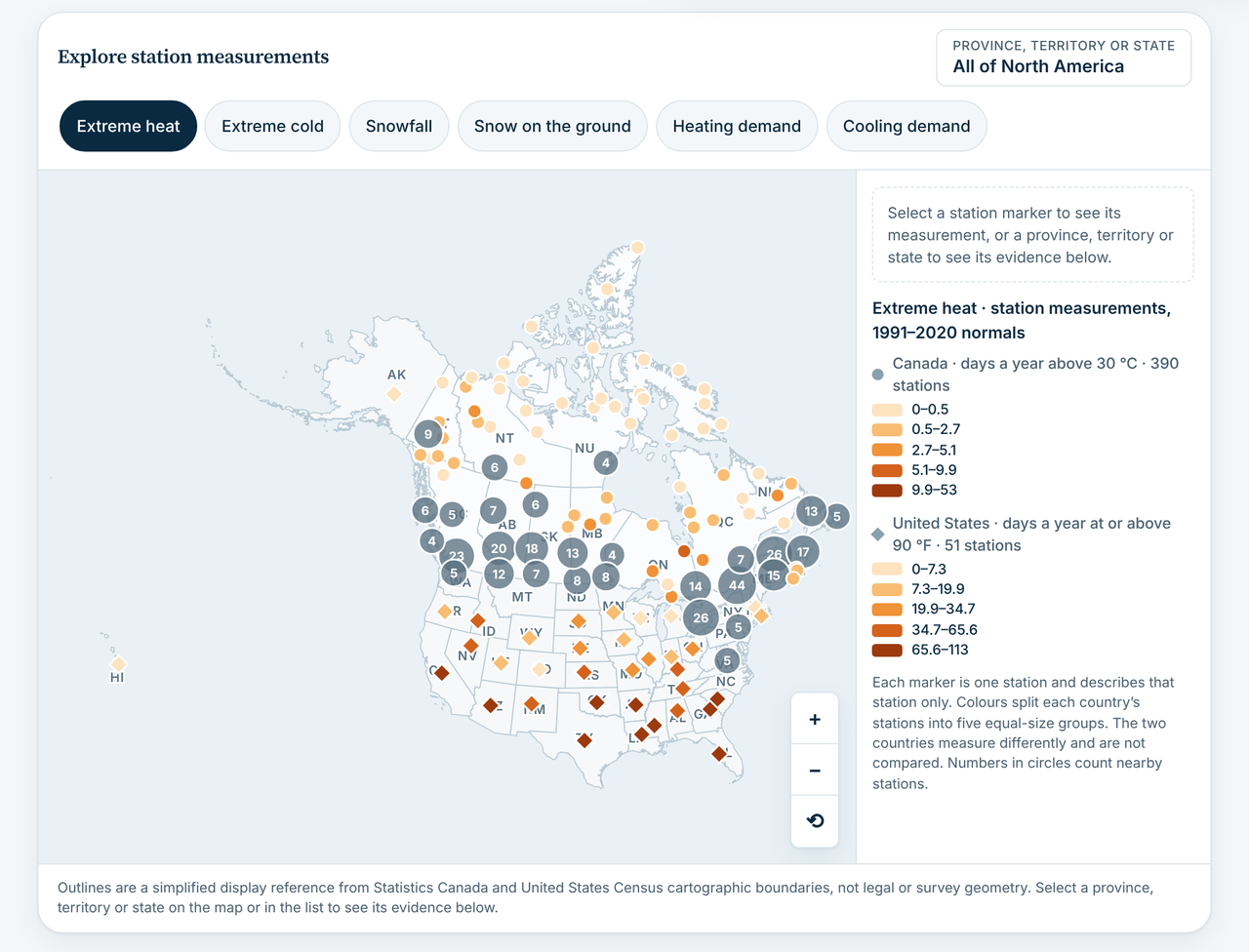
  • 1991–2020 climate normals from up to 421 Canadian stations and up to 6,850 U.S. stations, depending on the measure
  • Current observations and official weather alerts, shown in the issuer’s own words
  • Plain explanations of what each condition may place demand on
  • Living Earth: terrain, lakes and rivers, climate stations and floods recorded in Canada on one map
Open the Almanac
Living Earth in the Earth Almanac, showing shaded terrain across Canada and the United States, with lakes, rivers, city names and climate station points.
Living Earth in the Earth Almanac. Screenshot of the published site.

Check a building

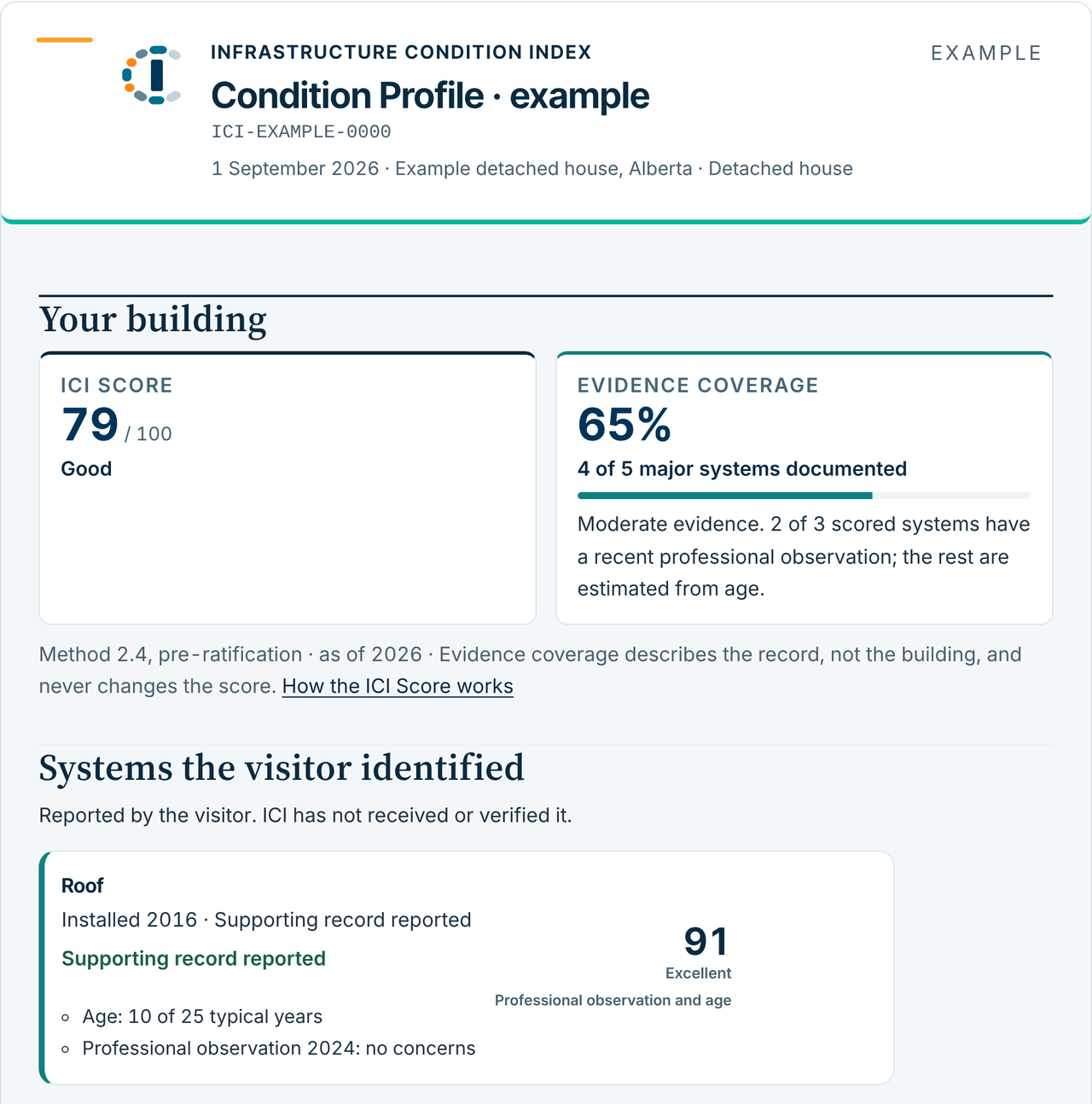
A few minutes of questions produce a dated Condition Profile: what is known about each system, what it rests on, and what is still missing.

  • Every answer labelled as a reported record, a best-known answer or not known
  • Missing information listed as a gap, never counted as a fault
  • Suggested next steps the owner can act on
See a sample profile
A sample Condition Profile listing building systems, the evidence behind each one and the information still missing.
The sample Condition Profile. Example data, not a real building. Screenshot of the published site.

One resource, two countries

Built for communities across Canada and the United States

The same building questions come up on both sides of the border. ICI answers them in one place, from each country’s own public sources, in the same plain format.

Canada

  • Look up a postal area
  • Climate normals and weather alerts from Environment and Climate Change Canada
  • Recall notices from Health Canada

United States

  • Look up a five-digit ZIP code
  • Climate normals from NOAA and alerts from the National Weather Service
  • Recall notices from the U.S. Consumer Product Safety Commission

Coverage differs by country, place and measure. Where ICI has no verified measurement for a place, it says so rather than filling the gap. Founding partners can help close those gaps.

The Earth Almanac station map of North America, showing Canadian and United States weather stations coloured by their average number of very hot days a year in the 1991 to 2020 climate normals, with each country measured on its own scale.
The Earth Almanac across North America, 1991–2020 climate normals. Each country’s stations are measured on their own scale. Screenshot of the published site.

What founding partnerships can make possible

Take a working public resource further

Each of these is a direction founding partners could support, agreed in writing and delivered openly. What ICI researches and publishes is decided independently.

  • Plain-language building guidance

    What heat, cold, rain and smoke can mean for a building and its equipment, free for everyone.

  • More places and measures

    Additional geographic coverage and data, so more communities can see what has been measured near them.

  • Research and method

    Independent research and methodology development, reviewed before anything is published.

  • Community preparedness

    Local programmes and tools that help owners and community groups prepare the buildings they rely on.

In development: community resilience research

ICI is researching a method for describing how prepared a community’s buildings are for the conditions they face, which could one day become a community resilience measure. It is a development direction, not a published or verified risk score, and nothing on the site uses it today. Founding partners can help support the research and independent review it needs.

A first initiative partners could support

What This Warning Means for Your Building

Proposed. Not yet operating.

When an official weather warning is issued, most people know what is coming, but not what it could mean for their roof, windows, drainage or equipment. This proposed series of plain-language guides would translate official hazard information into practical considerations for a building, starting with five common hazards.

ICI does not issue warnings. It does not replace government warning systems or emergency services, or the advice of qualified contractors, engineers and other professionals. Official warnings and safety instructions always take precedence.

The weather warning tells you what’s coming. ICI helps you understand what it could mean for your building.

  • High winds
  • Hail
  • Heavy rainfall
  • Extreme heat
  • Severe winter weather

Each guide would cover

  1. What the official warning saysin the issuing agency’s own words, with a link to the source.
  2. What it may mean for your buildingthe roof, windows, drainage, equipment and other parts that can be affected.
  3. Safe steps to considerbefore and during the event. Official instructions always come first, and a guide would never suggest anything dangerous, such as going onto a roof in high winds.
  4. What to document afterwarddates, photographs and notes that help when speaking with a contractor or insurer.

What founding partners may receive

A visible role in a public resource

Each founding partnership is a written commercial agreement. Depending on what it covers, it may include:

  • Public recognition by nameas set out in the signed agreement, before anything is published
  • Joint educational campaignson topics agreed with ICI, with sponsorship disclosed
  • Webinars and speaking opportunitiesshared sessions for your customers, members or staff
  • Logos, joint announcements or co-branded materialsonly with separate written approval from both organizations
  • Reach through your own networksways to bring ICI to your employees, members and customers, with outreach reporting where it is available
  • Preparedness and recovery initiativesopportunities to support separately funded projects as they are developed

Benefits are agreed in writing for each partnership. Nothing here is offered or guaranteed before an agreement is signed, and no audience size, media impressions, leads or financial return is promised.

Three people in winter clothing checking a storm drain and outdoor equipment beside a row of buildings.
Illustrative photograph. It does not show a particular project or event.

Looking ahead

Preparedness and recovery, close to home

Proposed. Not yet operating.

ICI is exploring how manufacturers, suppliers, qualified local contractors and other organizations could support practical preparedness and recovery projects. Examples include sponsoring eligible repairs, equipment replacements or documented installations after severe weather.

Any such program would put the people and households affected first. It would rely on qualified local work and document what was done, and it would not be run as a marketing exercise.

Our commitment

Partners support the resource. They never shape what it says.

ICI’s public information and interpretation stay independent of commercial sponsors. Sponsors do not buy influence over measurements, methodology or public findings, and sponsorship never influences how environmental information is interpreted. Sponsored content is always identified as sponsored. Sponsorship does not provide privileged access to personal information, private building records or non-public ICI data. Sponsors may use the same publicly available information as everyone else.

Infrastructure Condition Index is operated by Harmelo Corp., a company based in Calgary, Alberta. ICI is not a charity, and partnership payments are commercial agreements, not donations.

Questions organizations ask

Is a partnership a donation?

No. ICI is operated by Harmelo Corp., a company. Partnerships are commercial sponsorship and collaboration agreements. They are not charitable donations, and no charitable tax receipts are issued.

What does a founding partnership cost?

Terms depend on what a partnership covers, so we discuss them privately with each organization. No prices are published.

Will our name or logo appear on the site?

Your organization’s name is recognized publicly as set out in the signed agreement, before anything is published. Logos, joint announcements, testimonials or anything that suggests ICI endorses your organization need separate approval from both organizations. Until an agreement is signed, ICI names no partners.

Is ICI only for Canada?

No. ICI serves Canada and the United States. Coverage differs by place and measure, and partnerships can help extend it.

Does a partner receive data about visitors?

No. Partners do not receive information about individual visitors, their buildings or their use of ICI. Any reporting a partner receives is about outreach and engagement, where it is available.

How is sponsorship disclosed?

Any sponsored resource names its sponsor where people see it. Sponsorship never changes measurements, methods, findings or safety guidance.

Does a partnership change how ICI handles personal information?

No. The same Privacy Policy applies whether or not a resource has a sponsor. A partnership does not change what ICI collects, and partners receive no information about individual visitors or their buildings. Sponsorship does not provide privileged access to personal information, private building records or non-public ICI data. Sponsors may use the same publicly available information as everyone else.

Can partners influence what ICI publishes?

No. Measurements, methodology and public findings are decided independently of sponsors, and any sponsored material is labelled as sponsored.

Become a Founding Partner

Start a conversation

Tell us a little about your organization and what interests you. A person at Harmelo Corp. reads every inquiry and replies directly.

  1. We read your inquiryand reply personally, usually within a few business days.
  2. We talk it throughwhat you hope to support, and what fits ICI.
  3. We agree terms privatelyBenefits and deliverables are written into the agreement. Nothing is announced before it is signed.

Prefer email? Write to partnerships@harmelo.com.

A city skyline across a wide river on a summer day, with trees along the riverbank.

Help shape the next stage of ICI.

ICI is free, public and already working across Canada and the United States. Founding partners can help identify community needs, support new educational resources and expand the reach of ICI. Our research priorities, methods and findings remain independently governed.